Zuck’s death
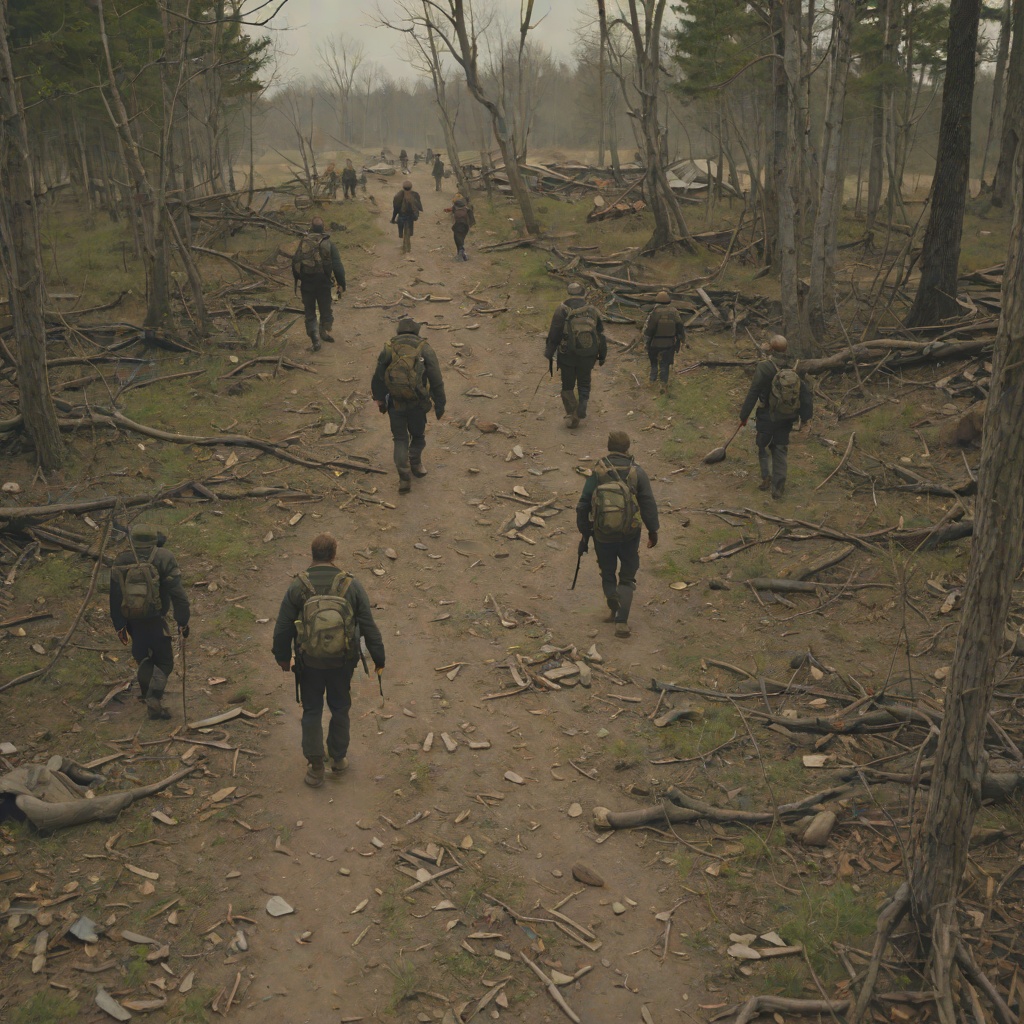
The Long WalkZuck’s death is the first sustained, unmistakable demonstration that injury cannot be separated from the Long Walk’s killing machinery. After Zuck has spent miles limping and bleeding, his body becomes a public countdown: warnings, renewed effort, pursuit by the halftrack, and finally gunfire. The episode turns a Walker’s attempt to survive into another stage of the Event, while the absence of a body afterward intensifies the sense that the system can erase a person as completely as it records him.
Causes and Background
Zuck’s decline is presented as a consequence of accumulated physical damage rather than a sudden failure of will. By late afternoon, other Walkers notice that he is “really hurting.” His injured knee continues to bleed, leaving tiny dark spots on the drying road. The image is materially precise: the blood is not an abstraction but a trail laid down by each step, evidence that the pace of the Walk is consuming him even while he remains technically in motion.
The injury also exposes the narrowness of the rules. A fall or slowdown that might ordinarily call for treatment instead becomes a punishable breach of speed. The Walkers understand this before Zuck does, or before he can emotionally accept it. The warning system transforms illness and injury into administrative facts, and each warning brings Zuck nearer to a ticket. His body is thus caught between two incompatible demands: it must continue walking as though it were intact, yet its bleeding knee continually demonstrates that it is not.
The surrounding atmosphere makes the danger harder to deny. At four-thirty, the Walkers have covered thirty miles, and the sun has sunk half below the horizon, turning the western sky blood red. Garraty feels panic at the thought that this may be the last daylight of his life. Against that background, Zuck’s condition is not merely one boy’s private crisis; it becomes a visible omen of what the coming night may bring to everyone still on the road.
The Attempt to Escape
The decisive turn comes with the announcement of Zuck’s third warning: “Warning! Warning 100! Your third warning, 100!” Zuck looks around with a dazed, uncomprehending expression, his right trouser leg stiff with dried blood. Then, instead of continuing at his failing pace, he suddenly sprints. The movement is startling because it reverses the apparent logic of his condition. The injured Walker does not recover; he spends the last reserve of his body in a desperate burst.
Zuck weaves through the other Walkers like a broken-field runner carrying a football. The comparison gives his flight a brief shape of athletic purpose, but the damaged body beneath it cannot sustain that illusion. His run is described as queer, shambling, and limping. When the wound opens again, fresh blood splashes from the cuff of his pants. The sprint therefore becomes both an act of resistance and an accelerated exposure of his vulnerability: every attempt to escape the rule makes the injury more visible.
For a moment, Zuck reaches open ground ahead of the main pack. He runs up the next rise and is silhouetted against the red sky as a black figure frozen in midstride. The image gives him a fleeting visual independence, as if distance and elevation might restore the possibility of choice. But the halftrack has increased its speed. The machinery of enforcement does not need to argue with his attempt or negotiate its meaning; it simply follows.
The Execution
The soldiers who have been walking with the boys drop back toward the halftrack, and the pursuit separates Zuck from the main group. The Walkers say nothing as they listen. The silence lasts long enough to become its own form of witnessing, broken only by a bird, early May crickets, and the drone of a plane somewhere behind them. The ordinary sounds of the landscape continue while the execution is being prepared, making the violence feel both spectacularly public and chillingly routine.
A single sharp report finally breaks the silence. There is a pause, then a second shot. Someone explains the interval with the sickened phrase “Making sure,” reducing the shooting to a procedural confirmation that the first bullet has produced the required result. The wording also reveals the event’s cruel uncertainty: death is not accepted as complete until the armed system verifies it.
When the Walkers crest the rise, the halftrack is sitting on the shoulder half a mile away, blue smoke issuing from its dual exhaust pipes. Zuck is gone. There is “no sign at all” of him. His disappearance contrasts sharply with the earlier visibility of his blood, limping run, and silhouette. The road had displayed his suffering in minute physical traces; the completed execution removes the body and leaves only smoke, distance, and the knowledge that the state’s procedure has been carried out.
Consequences and Aftermath
Zuck’s death changes the Walk’s emotional and statistical register. Earlier deaths have already taught the Walkers that the rules are lethal: Curley is shot after falling below speed, and Ewing is dragged aside and killed after he can no longer maintain the required pace. Yet Zuck’s case adds a distinct pattern. He is not simply overtaken by exhaustion at the exact moment of collapse; he makes a conscious, frantic attempt to outrun the warning, and the enforcement vehicle answers by pursuing him. The system therefore appears not merely to punish failure but to absorb resistance into its spectacle of control.
The death also clarifies how quickly individual identity is converted into numbers. After two earlier Walkers are gone, Garraty thinks of the odds as having been adjusted infinitesimally in favor of those remaining. Later, he hears the distance and casualty count rendered in the language of progress: about eighty miles covered, twenty-seven Walkers gone, a quarter of the way home. At the end of the first twenty-four hours, ninety-nine miles have been covered while thirty-six have disappeared. Zuck’s death belongs to this arithmetic, even though the scene insists on the singular details that statistics suppress: the dried blood, the reopened wound, the shambling run, and the blue smoke.
That conversion becomes explicit in Garraty’s later response to Hank Olson’s death. Garraty insists that Olson was alive until the soldiers shot him, while Peter McVries answers that Olson is only a number in the body count. The exchange supplies a retrospective measure of what Zuck’s disappearance means. The Walker who had been visible as a hurting boy is reduced to a completed count, and the group is expected to continue walking without ceremony. The same emotional pressure later shapes Garraty’s fear that, if he buys his ticket, the others will keep moving and the official record will contain only his name, number, elimination point, and a brief newspaper human-interest story.
Narrative Significance
Zuck’s death establishes the Long Walk as a closed system in which warning, surveillance, public attention, and lethal force form one continuous process. The Major’s poised hand and chronometer represent the suspense of official timing, but the road’s deeper terror lies in the fact that everyone already knows what the timing authorizes. The silence before the shots is not ignorance; it is collective recognition of a rule that has become normal through repetition.
The event’s value shift is absolute. Zuck begins the sequence as an injured but still participating Walker, then turns his remaining strength into apparent motion toward freedom. The result reverses that hope: the sprint ends not in safety but in a more exposed and more final form of capture. His body moves faster, yet his available future contracts to two gunshots. This reversal gives the scene its particular force and distinguishes it from a simple account of someone falling behind.
Finally, the event makes absence itself part of the Long Walk’s violence. Curley’s body remains visibly on the white line after his head is destroyed, while Zuck leaves behind no sign at all beyond the halftrack’s smoke. The contrast shows two complementary forms of dehumanization: one body is reduced to obscene debris in front of the group, and another is removed so completely that the execution leaves the survivors with no physical object on which to focus their grief. In both cases, the Walk continues, and the dead are folded into the count that measures the living’s dwindling chances.